What is an MOU and when do you need one? Complete guide covering MOU vs contract, what to include, and a free editable Memorandum of Understanding template.
What Is a Memorandum of Understanding?
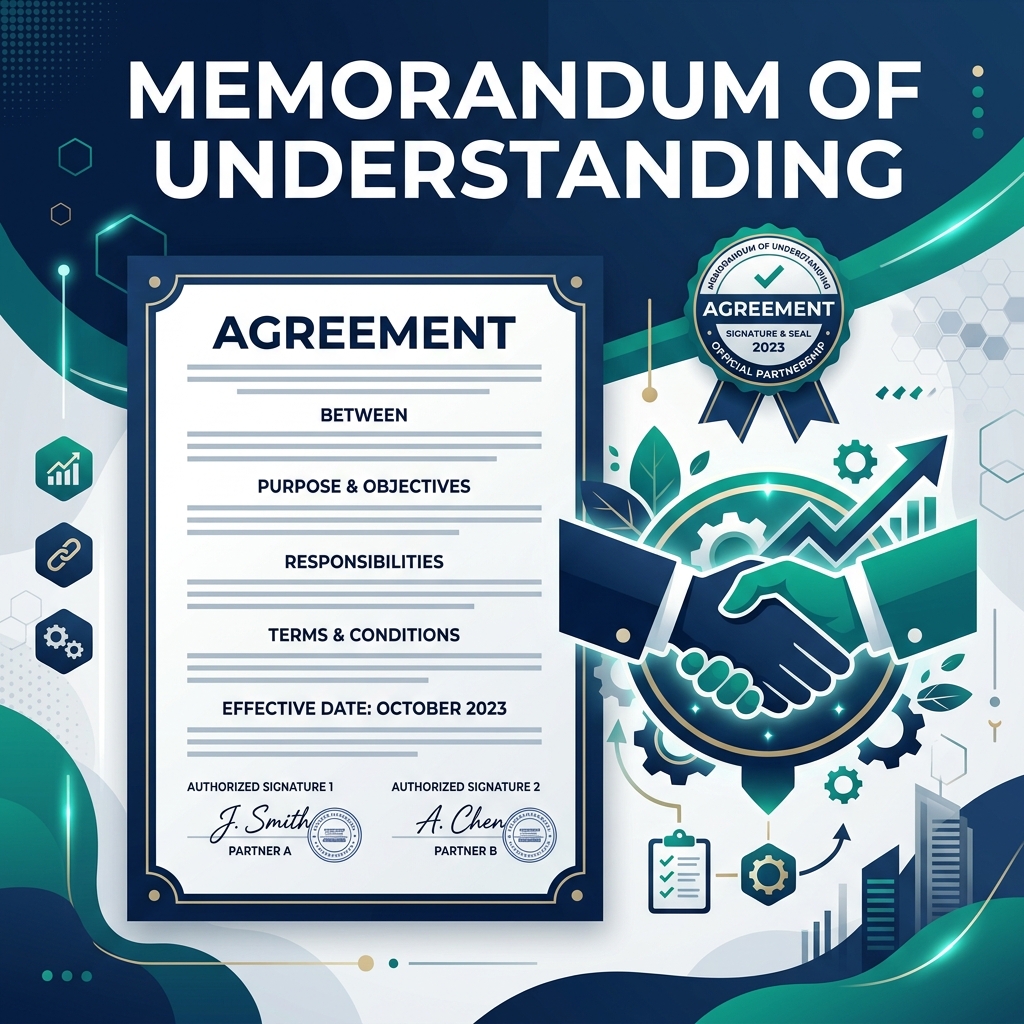
A Memorandum of Understanding (MOU) is a written document that outlines the agreed intentions, responsibilities, and framework of a proposed relationship between two or more parties — before a formal binding contract is negotiated and signed. It is a statement of intent, not a final agreement.
Think of it as the handshake written down: "We agree on the broad outlines. Here is what we each intend to do. We will formalise the details in a contract shortly." MOUs are widely used in business partnerships, government agreements, international relations, and nonprofit collaborations.
MOU vs Contract — Key Differences
| Feature | MOU | Contract |
|---|---|---|
| Legal binding? | Usually not (unless specific clauses make it so) | Yes — legally enforceable |
| Purpose | Establish intent and framework | Bind parties to specific obligations |
| Specificity | High-level, broad | Detailed, specific |
| When used | Early in the relationship, before full terms are agreed | When all terms are negotiated and agreed |
| Consequence of breach | Limited (reputational, not usually legal) | Legal remedies including damages |
MOU vs Letter of Intent (LOI)
Both are non-binding expressions of intent, but they serve slightly different contexts. A letter of intent is more common in acquisition, real estate, and commercial transactions — it typically sets out the basic terms of a deal. An MOU is more common in partnerships, collaborations, and government-to-government agreements where the relationship (not just the transaction) is being established.
When to Use an MOU
- Starting a business partnership before all terms are negotiated
- Establishing a collaboration between two organizations (NGOs, universities, government agencies)
- Framing a joint venture before the full joint venture agreement is drafted
- Agreeing the terms of a supplier relationship before the formal supply agreement
- Documenting the intent of an acquisition or merger before due diligence is complete
What to Include in an MOU — 12 Elements
- Party names. Full legal names of all organizations or individuals involved.
- Date and effective period. When the MOU comes into effect and how long it runs (or whether it continues until a formal contract is signed).
- Purpose and background. Why this MOU is being entered into — what both parties are trying to achieve.
- Scope of the relationship. What the collaboration covers and (importantly) what it does not.
- Roles and responsibilities. What each party will do — at a high level.
- Resources and contributions. What each party will provide — funding, staff, facilities, data, IP.
- Decision-making process. How joint decisions will be made — who has authority over what.
- Confidentiality. Whether information shared during the relationship is confidential.
- Intellectual property. Who owns any jointly developed outputs.
- Dispute resolution. How disagreements will be handled — mediation, escalation process.
- Termination. How either party can exit the MOU and with how much notice.
- Non-binding statement (if applicable). A clause explicitly stating the MOU is not legally binding (beyond the confidentiality and IP clauses, if those are intended to bind).
MOU Example (Excerpt)
This Memorandum of Understanding is entered into between [Organization A] and [Organization B] (together "the Parties") as of [Date].
Purpose: The Parties intend to collaborate on the development and delivery of [Program Name], with the goal of [objective]. This MOU establishes the framework for cooperation and is intended to be superseded by a formal agreement once full terms have been negotiated.
Roles: Organization A will [responsibilities]. Organization B will [responsibilities].
Duration: This MOU is effective from [start date] and will remain in force until [end date or "the execution of a formal agreement"], whichever is earlier, unless terminated earlier by mutual written consent.
Non-Binding: Except for the provisions on Confidentiality (Section X) and Intellectual Property (Section Y), this MOU is not legally binding and does not create enforceable obligations on either Party.
Is an MOU Legally Binding?
Generally, no — but it depends on the language used. If an MOU includes the elements of a contract (offer, acceptance, consideration, and intention to be legally bound), a court may treat it as binding. To be safe, explicitly include a "non-binding" clause stating that the MOU is a statement of intent only. However, if you include confidentiality or exclusivity provisions, those specific clauses typically are intended to be binding, and should be drafted clearly as such.
Frequently Asked Questions
Can an MOU be used as evidence of a contract?
In some circumstances, yes — if a court finds that the MOU contains all the elements of a contract and the parties acted as though it was binding. This is why a clear "non-binding" statement is important.
Does an MOU need to be signed by both parties?
Yes. Without signatures, it is just a document — not even a statement of mutual intent. Both parties should sign and retain a copy.
How long does an MOU last?
You specify the duration. Common approaches: a fixed term (6 or 12 months), "until a formal contract is signed," or "indefinitely until terminated with 30 days' notice."
What is the difference between an MOU and an MOA?
A Memorandum of Agreement (MOA) is more specific and is often intended to be legally binding (unlike a typical MOU). An MOA is used when parties are ready to commit to specific obligations — it sits between an MOU and a full contract in formality.
Do I need a lawyer to draft an MOU?
For a simple collaboration between two businesses, a template MOU is sufficient. For complex partnerships involving significant money, IP, or government agencies, legal review is advisable — especially to ensure the non-binding clauses say exactly what you intend.
For more ready-to-use layouts, check out our collection of free document templates to speed up your paperwork.
2026 Legal Protection & Payment Guarantee Checklist
Protect your intellectual property and guarantee payment before project kickoff:
AI Confidentiality Clause
Ensure client proprietary assets are never fed into public LLM training datasets.
IP Transfer on Final Settlement
Condition deliverable copyright transfers strictly upon 100% receipt of final payment.
Deposit & Phased Milestone Gates
Mandate a 30% to 50% upfront deposit before commencing any project execution.
Revision Limits & Kill Fees
Cap feedback cycles (e.g. 2 rounds) and specify out-of-scope compensation rates.


Reviewed by Finance & Document Structuring Specialists
Ready to put this into practice?
Browse Templix AI's free professional templates. Customize online, edit with AI, and download as PDF or Word — in minutes.