A winning sales proposal turns interested prospects into signed clients. This guide gives you the exact structure, section-by-section guidance, and a free template.
What Makes a Sales Proposal Win
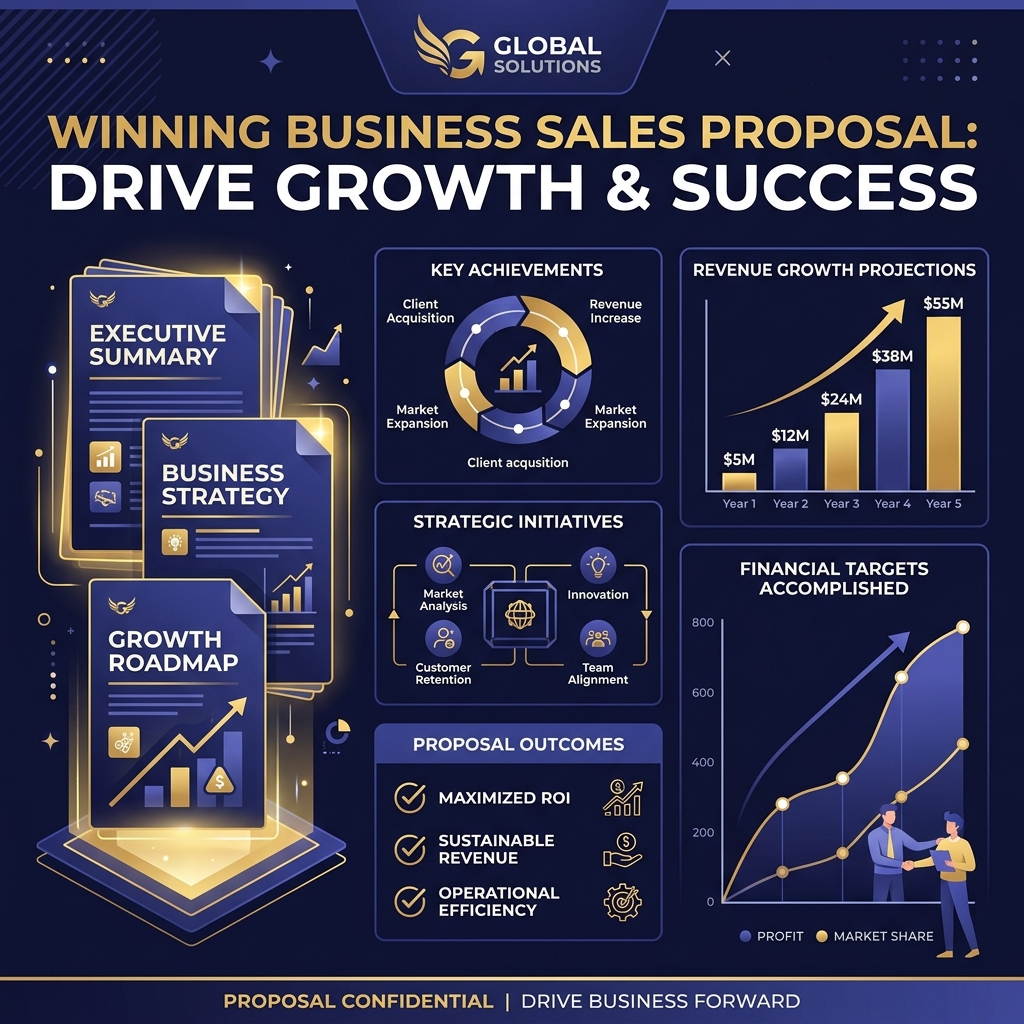
Most proposals fail not because the service is bad, but because the proposal is about the provider, not the client. The classic mistake: page one lists your company history, credentials, and awards. Page two lists your services. Page three — finally — mentions the client's situation.
The best proposals reverse this. They start with the client's problem, stated more clearly than the client has stated it themselves. Everything else follows from there.
Sales Proposal Structure — 9 Sections
Section 1 — Cover Page
Your company name, the client's company name, the proposal title, and the date. Add a relevant image or branded graphic. Keep it clean — it is the first impression before they open the document.
Section 2 — Executive Summary
A 1-page summary written for the decision-maker who will not read the full document. It covers: what problem the proposal solves, your proposed solution, the expected outcome, and the investment. Write this last, after the rest of the proposal is complete.
Section 3 — The Client's Problem
Describe the client's situation and the specific problem you are solving — in their language, not yours. If you have done your discovery call properly, this section should make the client think "they really understand us." Include the impact of not solving the problem (cost, time, risk). This is the section that earns you the read.
Section 4 — Your Proposed Solution
Describe your approach — what you will do, in what order, and why. Avoid generic descriptions like "we will develop a custom solution." Be specific: what you will deliver, how you will deliver it, and what makes your approach better than the alternative.
Section 5 — Deliverables and Timeline
A clear list of what the client will receive and when. Use a table or a milestone timeline:
| Week | Milestone | Deliverable |
|---|---|---|
| 1 | Discovery | Requirements document, project plan |
| 2–4 | Development Phase 1 | Prototype / first draft |
| 5 | Review | Client feedback incorporated |
| 6 | Final delivery | Complete package, handover documentation |
Section 6 — Proof (Case Studies / Testimonials)
One or two short case studies from similar clients — showing the problem they had, your solution, and the measurable outcome. Real numbers beat vague praise: "reduced onboarding time by 40%" is worth ten "they were amazing to work with" testimonials.
Section 7 — Pricing
Present 2–3 pricing options (basic / standard / premium), if possible. This anchors the conversation — clients choose between your options rather than between you and a competitor. Be transparent: break down what is included at each level. State clearly what is not included.
Section 8 — Terms and Conditions
Key points only: payment schedule, revision policy, IP ownership, what happens if the project scope changes. Reference your full contract if you have one — don't reproduce all legal clauses in the proposal itself.
Section 9 — Next Steps
A specific, low-friction call to action. Not "let us know if you'd like to proceed" — that puts the burden back on the client. Instead: "To get started, sign this proposal and we'll schedule the kick-off call. I'm available [dates]." Make it easy to say yes.
Sales Proposal Mistakes That Lose Deals
- Starting with your credentials. Lead with the client's problem.
- One pricing option. Multiple options create an anchoring effect that increases average deal value.
- No clear next step. Decision-makers are busy — tell them exactly what to do and how to do it.
- Too long. A 40-page proposal suggests you don't understand your own solution. Most winning proposals are 8–15 pages.
- Generic case studies. A case study from a different industry doesn't build the confidence a relevant one does.
Frequently Asked Questions
What is the difference between a sales proposal and a quote?
A quote lists prices with minimal context. A proposal explains the problem, the solution, and the value — then states the price. Proposals win at higher price points; quotes work for commodity purchases where price is the main decision factor.
How long should a sales proposal be?
8–15 pages for most B2B proposals. Complex enterprise proposals may run longer — but lead with your strongest material. Decision-makers often only read the executive summary and the pricing section in detail.
Should I send the proposal before or after a discovery call?
Always after. A proposal sent without a discovery call is a guess. A proposal written after a thorough call addresses the client's actual situation, which is infinitely more persuasive.
How do I follow up after sending a proposal?
Wait 3 business days, then send a brief follow-up: "Just checking you received the proposal and asking if you have any questions." One follow-up is professional; three unprompted ones are not. If they haven't responded after two follow-ups, move on.
What is the acceptance rate for sales proposals?
Industry averages vary widely (10–50%), but the strongest predictor of acceptance is the quality of the discovery process before writing. The better you understand the client's situation, the higher your close rate.
For more ready-to-use layouts, check out our collection of free document templates to speed up your paperwork.
2026 Proposal Conversion & RFP Win Checklist
Transform dense document pitches into high-converting visual sales narratives:
Client-Centric Problem Framing
Mirror the client's exact operational friction points before presenting your solution.
Visual Milestones & Timelines
Use structured phases and deliverables matrices rather than dense walls of text.
Tiered Pricing Menu (3 Tiers)
Provide Core / Growth / Premium options to anchor value and increase deal size.
1-Click Digital Signoff
Include clear acceptance terms, validity expiry window, and digital signature blocks.


Reviewed by Finance & Document Structuring Specialists
Ready to put this into practice?
Browse Templix AI's free professional templates. Customize online, edit with AI, and download as PDF or Word — in minutes.