Writing a proposal for a client? This guide covers the universal structure and tailors it to 7 industries — web design, marketing, consulting, IT, events, construction, and grants.
What Is a Client Proposal?
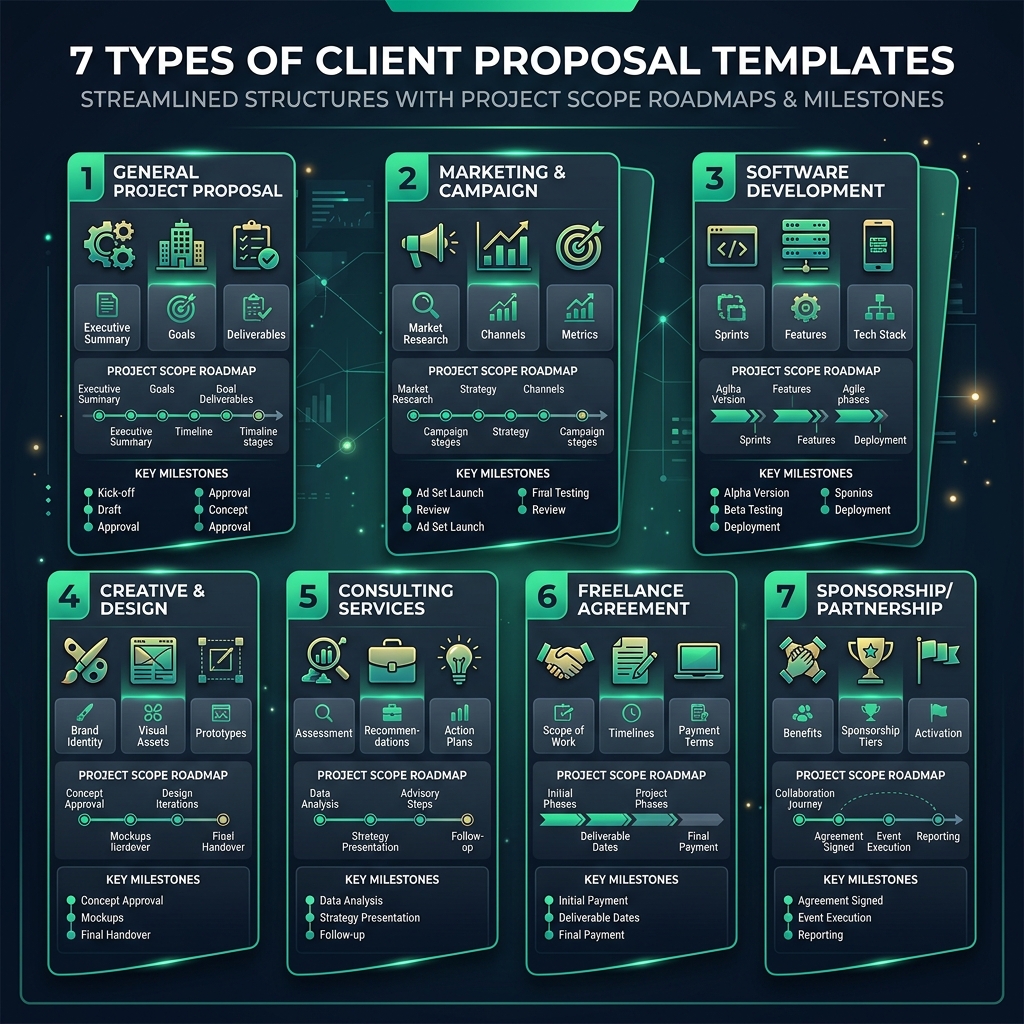
A client proposal is a document you send to a potential client that explains: the problem you understand them to have, the solution you are proposing, how you'll deliver it, when, and how much it will cost. It is persuasive (it is designed to win the work) and operational (it defines what will happen if the client says yes).
A proposal is not a quote (which is just a price list), not a pitch deck (which is for live presentations), and not a contract (which comes after the proposal is accepted). It is the bridge between interest and commitment.
The Universal Proposal Structure — 7 Sections
- Cover Page — project name, client name, your name, date
- Executive Summary — 1-page overview for the decision-maker
- Problem Statement — the client's specific challenge, in their language
- Proposed Solution — your approach and methodology
- Deliverables and Timeline — what, when, in what format
- Pricing — investment options with what each includes
- Next Steps — specific call to action with a deadline
Every proposal type below uses this structure — but the emphasis, language, and specifics differ by industry.
Type 1 — Web Design Proposal
What to emphasize: Your design process (discovery → wireframes → design → development → launch), the number of pages, technology stack, responsive design, and post-launch support.
Key deliverable details to specify: Number of pages, mobile/desktop, browser compatibility, CMS (if any), whether copywriting is included, SEO optimization, revision rounds.
Common pricing models: Fixed project price (most common), hourly rate for ongoing changes.
Type 2 — Digital Marketing Proposal
What to emphasize: Current state analysis (traffic, rankings, conversion rate), specific goals (leads, traffic, ROI), your strategy and monthly activities, and how results will be reported.
Key deliverable details: Monthly hours, channels covered (SEO, PPC, email, social), reporting cadence, tools used, who provides ad spend budget.
Common pricing models: Monthly retainer (most common), % of ad spend + management fee.
Type 3 — Consulting Proposal
What to emphasize: Your understanding of the specific business problem, your diagnostic methodology, your track record with similar organizations, and the measurable outcome.
Key deliverable details: Phase structure (discovery, analysis, recommendations, implementation support), deliverable formats (reports, workshops, roadmap documents).
Common pricing models: Daily or weekly rate, fixed project fee, retainer.
Type 4 — IT / Software Development Proposal
What to emphasize: Technical architecture (without jargon), development methodology (Agile, sprint structure), testing and QA plan, security considerations, and post-launch support.
Key deliverable details: Technologies and frameworks, data security approach, API integrations, user roles, browser/device compatibility, source code ownership.
Common pricing models: Fixed price (for defined scope), time and materials (for evolving scope), hybrid.
Type 5 — Event Proposal
What to emphasize: Event concept and theme, venue and logistics, staffing, risk management, and how success will be measured (attendees, feedback scores, media coverage).
Key deliverable details: Venue sourcing, catering, AV/production, invitations, on-site management, post-event reporting.
Common pricing models: Fixed management fee + cost-plus for suppliers, all-inclusive flat fee.
Type 6 — Construction / Architecture Proposal
What to emphasize: Project phasing, regulatory compliance (planning permissions, building regulations), materials and specifications, health and safety, and subcontractor management.
Key deliverable details: Drawings and specifications included, site management, inspection schedule, defects liability period, insurance coverage.
Common pricing models: Fixed price tender, cost-plus with maximum GMP (Guaranteed Maximum Price).
Type 7 — Grant Proposal
What to emphasize: Alignment with the funder's mission and criteria, clear problem statement with supporting data, evidence of your organization's capacity to deliver, measurable outcomes, and budget justification.
Key differences from commercial proposals: Much longer (20–50 pages with appendices), highly structured (follow the funder's exact template), budget-heavy (line-by-line justification required), requires evidence of impact measurement.
Proposal Writing Tips That Close Deals
- Always do a discovery call first. A proposal written without understanding the client's actual situation is a guess.
- Lead with their problem, not your credentials. Credentials belong in section 5 — the client's problem belongs in section 2.
- Offer multiple pricing options. Anchoring effect: clients choose between your options rather than between you and a competitor.
- Set a proposal expiry date. "This proposal is valid for 30 days" creates gentle urgency.
- Follow up once, professionally, 3–5 days after sending. A simple "I wanted to make sure you received the proposal and ask if you have any questions" is all you need.
Frequently Asked Questions
How long should a client proposal be?
4–8 pages for freelance and small business proposals. 10–20 pages for complex enterprise or construction proposals. Grant proposals often run 20–50 pages with appendices. Match depth to complexity — never pad for the sake of appearing thorough.
Should I include terms and conditions in a proposal?
Yes — key terms only. Payment schedule, revision policy, IP ownership, termination. A full contract comes after acceptance; the proposal's T&Cs give the client advance notice of your commercial terms so there are no surprises.
What format should I send the proposal in?
PDF for sending — it looks professional, preserves formatting on any device, and cannot be accidentally edited. Internally, draft in Word or Google Docs for easy editing.
How do I price a project I've never done before?
Research the market rate, estimate the hours with a 20% contingency buffer, and consider the value to the client (not just your cost). If uncertain, provide a range with a clear scope definition at the lower end.
What if the client wants to negotiate the price?
Never simply reduce the price. Instead, reduce the scope: "I can do this for £X if we reduce the number of revision rounds from three to two and you provide all content by [date]." Preserving the value-to-price ratio is essential for the long-term health of the client relationship.
2026 Proposal Conversion & RFP Win Checklist
Transform dense document pitches into high-converting visual sales narratives:
Client-Centric Problem Framing
Mirror the client's exact operational friction points before presenting your solution.
Visual Milestones & Timelines
Use structured phases and deliverables matrices rather than dense walls of text.
Tiered Pricing Menu (3 Tiers)
Provide Core / Growth / Premium options to anchor value and increase deal size.
1-Click Digital Signoff
Include clear acceptance terms, validity expiry window, and digital signature blocks.


Reviewed by Finance & Document Structuring Specialists
Ready to put this into practice?
Browse Templix AI's free professional templates. Customize online, edit with AI, and download as PDF or Word — in minutes.