Write a freelance invoice that gets paid on time: every required field, sequential numbering, payment terms, tax lines, and a free template with no sign-up.
What a Freelance Invoice Must Include
An invoice is a formal request for payment and, in most countries, a required tax document. Whether you send one a month or one a day, every freelance invoice should contain the same core fields so clients can approve and pay it without friction.
- Your details — name or business name, address, email, and tax ID where applicable.
- Client details — company name, contact, and billing address.
- Invoice number — a unique, sequential reference such as INV-0042.
- Dates — the issue date and a clear due date, not just "Net 30".
- Line items — description, quantity or hours, rate, and line total.
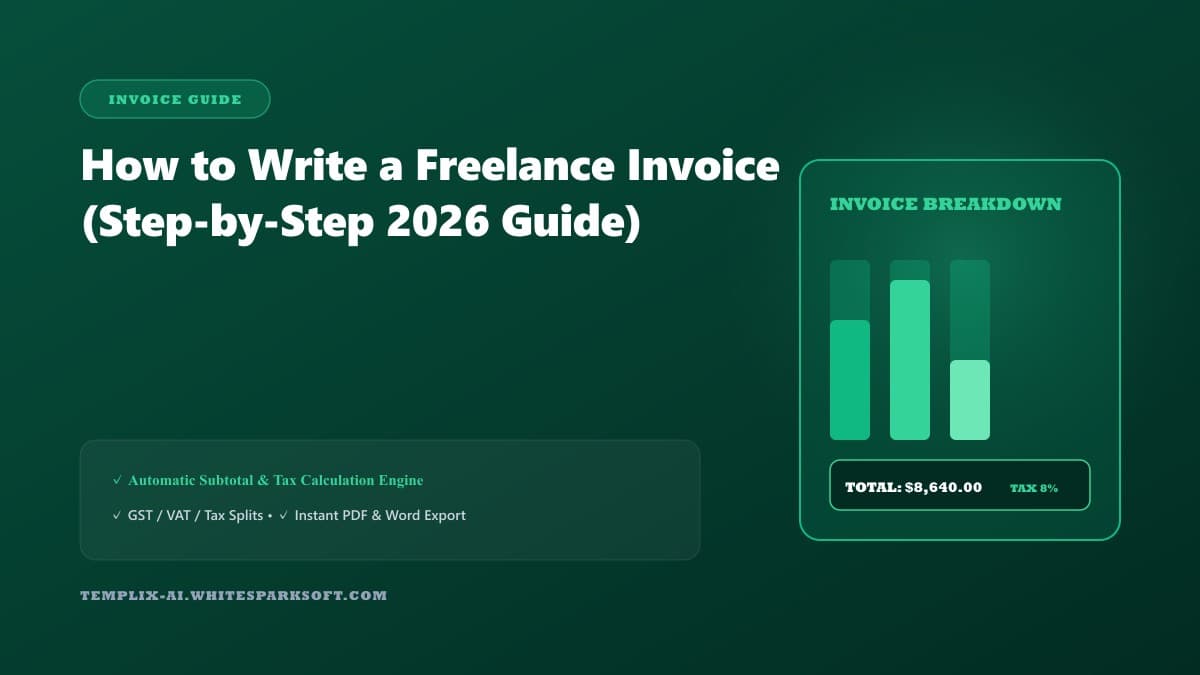
- Totals and tax — subtotal, applicable VAT/GST/sales tax, and the grand total.
- Payment instructions — accepted methods and account details.
Step-by-Step: Build the Invoice
- Start from a clean layout. You can grab a free invoice template collection and customize it in minutes.
- Add your branding and both parties' contact details.
- Assign the next sequential invoice number and set the issue and due dates.
- List each service as its own line item with a clear description.
- Apply tax if you are registered, then confirm the grand total.
- Write payment terms and a short thank-you note, then export to PDF.
How to Number Invoices
Use a consistent, sequential scheme so nothing is skipped or duplicated — auditors and accounting software both expect it. Popular formats include INV-0001 or a date-based pattern like 2026-07-001.
Setting Payment Terms That Get You Paid
| Term | Meaning | Best For |
|---|---|---|
| Due on receipt | Pay immediately | Small, one-off gigs |
| Net 15 | Pay within 15 days | Ongoing freelance clients |
| Net 30 | Pay within 30 days | Corporate clients and agencies |
| 50% upfront | Deposit then balance | Projects over $500 |
Don't Forget the Tax Side
In the United States, self-employed workers report invoice income to the tax authority — review the official guidance from the IRS Self-Employed Center. For a formal definition of the document itself, see the reference entry on invoicing standards.
Get Paid Faster
Send the invoice the day you finish, make paying easy, and follow up politely if it slips past due. For ready-to-send scripts, read our guide to late payment reminder emails.
2026 Invoice Compliance & Fast Settlement Checklist
Verify these core line items before dispatching your billing documentation:
Sequential & Distinct ID
Maintain structured, unbroken numbering (e.g. INV-2026-001) for clean tax audits.
Direct Payment Rails & Pay Now Button
Embed Stripe, ACH, or instant wire links directly on the PDF for 1-click settlement.
Itemized Tax & SAC/HSN Codes
Clearly isolate gross subtotal from applicable GST/VAT percentages and line deductions.
Explicit Due Dates & Late Terms
State exact calendar deadlines and recurring late-interest policies upfront.
Frequently Asked Questions
What should a professional invoice include?
A unique invoice number, your and the client's details, an itemized list of the work, the subtotal, any tax, the total due, and clear payment terms.
How do I get an invoice paid on time?
Number it sequentially, set an explicit due date rather than just "Net 30", list clear line items, and send it as a PDF the moment the work is done.
Are the templates on Templix AI really free?
Yes. Every template referenced in this guide is free to customize and download as PDF or Word, with no account and no watermark.
Can I export the finished document to PDF and Word?
Yes. Fill any template in the browser and export it to clean PDF or Word in a couple of clicks — the layout stays identical either way.


Reviewed by Finance & Document Structuring Specialists
Ready to put this into practice?
Browse Templix AI's free professional templates. Customize online, edit with AI, and download as PDF or Word — in minutes.